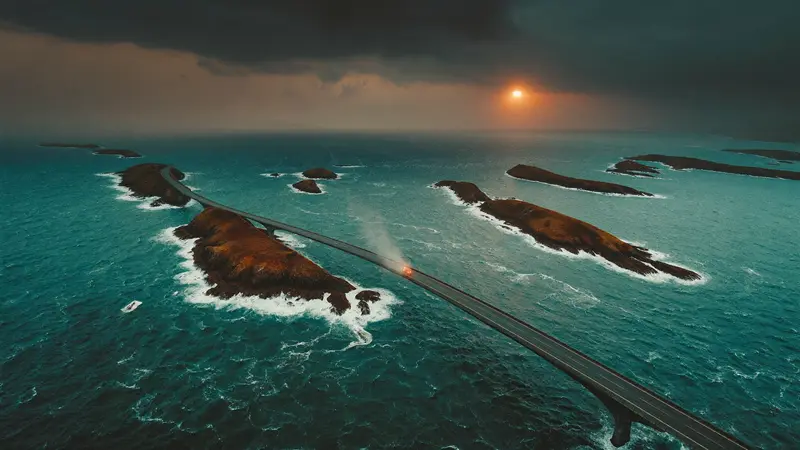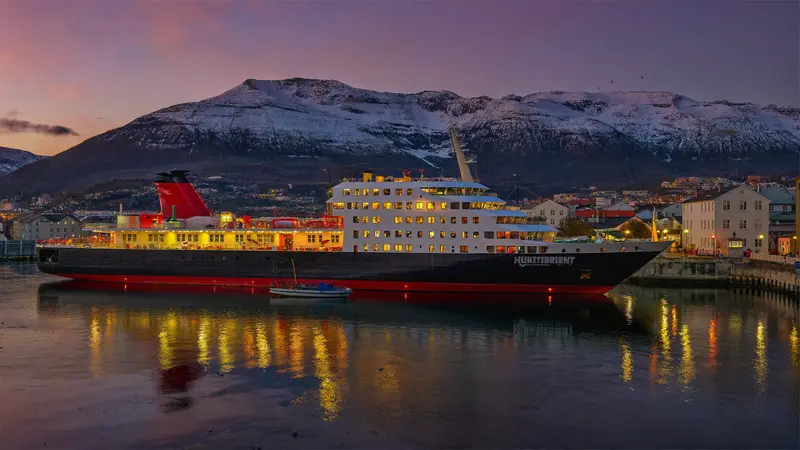
The Norwegian coastal voyage is the slow-travel classic: a working ship that threads the entire coast from Bergen to the Russian border, calling at 34 ports, crossing the Arctic Circle, and delivering fjords, islands and northern lights from your cabin window. Operated for over 130 years by Hurtigruten — and now also by Havila — it's part cruise, part ferry, part lifeline for the villages it serves. Here's how the coastal voyage works, what it costs, and whether it's right for your trip.
What is Hurtigruten?
Hurtigruten (literally "the fast route") began in 1893 as a mail-and-freight service linking Norway's isolated coastal communities. It still does that job — carrying locals, cars and cargo between ports — while also being one of the world's great scenic journeys. The full route runs Bergen ↔ Kirkenes, a 7-day one-way / 11–12-day round voyage covering roughly 2,500 nautical miles and 34 ports. Because it's a genuine working ship, it sails year-round, in all weather, day and night.
Hurtigruten vs a normal cruise
| Coastal voyage (Hurtigruten/Havila) | Big cruise ship | |
|---|---|---|
| Ship size | Small (a few hundred guests) | Large (thousands) |
| Ports | 34, many tiny, some at 2am | A handful of marquee stops |
| Feel | Expedition/ferry, understated | Resort-at-sea, entertainment |
| Best for | Scenery, immersion, flexibility | Onboard amenities, families |
This distinction matters more than ever: travellers increasingly want time in port and meaningful excursions over quick photo-stops, which is exactly the coastal voyage's strength. (It's also why cruise-heavy ports are adopting the tourist tax.)
The route and the highlights
Sailing north from Bergen, the voyage takes in Ålesund's art-nouveau harbour, the Geirangerfjord detour (summer), the Arctic Circle crossing, the Lofoten and Vesterålen islands, Tromsø, Norway's northernmost communities, and the North Cape, before ending at Kirkenes. You can sail one-way and fly back, do the full round trip, or ride a single leg as scenic transport between two towns.
Best time to take the coastal voyage
- Winter (Nov–Mar): the northern lights voyage — sail under the aurora; some operators offer an aurora guarantee. Pair with our aurora guide.
- Summer (Jun–Jul): the midnight sun voyage — 24-hour daylight above the Arctic Circle and the Geiranger detour. See the midnight sun guide.
- Shoulder (May, Sep): fewer guests, spring waterfalls or autumn colour, good value.
Ride a single leg. You don't have to commit to a week. Sailing one scenic stretch — say Bergen to Ålesund, or Tromsø to the Lofoten islands — is a brilliant, affordable way to swap a long drive for a fjord cruise, and it doubles as transport on a bigger itinerary.
What does it cost?
A full voyage with cabin and meals is a premium trip — think comparable to a mid-range cruise — but the range is wide depending on season, cabin grade and how much is included. Port-to-port legs booked as transport are far cheaper. As with everything in Norway, book early for summer and aurora-season sailings, and read our cost breakdown to place it in your overall budget.
Is the coastal voyage right for you?
Yes if you love scenery over nightlife, want to see the whole coast including places no road reaches, and like the idea of unpacking once while Norway slides past. Maybe not if you need big-ship entertainment, kids' clubs and pools, or you're on a tight budget — in which case a self-drive road trip or day cruises from Bergen give you more control for less.
Experiences along the coastal route
Lofoten: Trollfjord Cruise by Silent Electric Ship
Glide into the impossibly narrow Trollfjord on a silent electric ship — sea eagles overhead and 1,000 m walls on either side.
From Ålesund: Round-Trip Cruise to the Geirangerfjord
Sail the full UNESCO Geirangerfjord and back from Ålesund in a day — no mountain passes, no driving, all the scenery.
From Bergen: The Original Mostraumen Fjord Cruise
The classic 3-hour cruise from Bergen harbour into the narrow Mostraumen strait, under waterfalls — running year-round.
Tromsø: Whale Watching by Hybrid-Electric Boat
Near-silent hybrid-electric sailing to find orcas and humpbacks in the Arctic fjords — quieter for you and kinder to the whales.
Heads up: booking through the links above supports Ritzyme at no extra cost to you. Prices and availability are set by the provider — always confirm details on the booking page.
However you travel the coast, the western fjords near Bergen are the easiest place to sample the magic on a day trip before committing to a full voyage — the perfect taster.
Frequently asked questions
What is the difference between Hurtigruten and a cruise?
Hurtigruten (and Havila) run small working ships that carry locals and cargo to 34 ports, many tiny, some at night. It's an immersive, scenery-first experience rather than a big resort-style cruise with thousands of guests and onboard entertainment.
How long is the Norwegian coastal voyage?
The full Bergen–Kirkenes route is 7 days one-way or 11–12 days round trip, calling at 34 ports and crossing the Arctic Circle. You can also ride a single leg between two towns as scenic transport.
When is the best time to take Hurtigruten?
Winter (November–March) for northern lights, some sailings with an aurora guarantee; summer (June–July) for the midnight sun and the Geiranger detour; May and September for fewer guests and good value.
Is the Hurtigruten coastal voyage worth it?
If you love scenery over nightlife and want to see the whole coast — including places no road reaches — while unpacking once, yes. If you need big-ship amenities or are on a tight budget, a self-drive trip or day cruises from Bergen may suit better.
Ritzyme is reader-supported. Some links in this guide are affiliate links (marked as sponsored) — if you book through them we may earn a small commission at no extra cost to you. We only recommend experiences we’d take ourselves, and commissions never change our rankings.